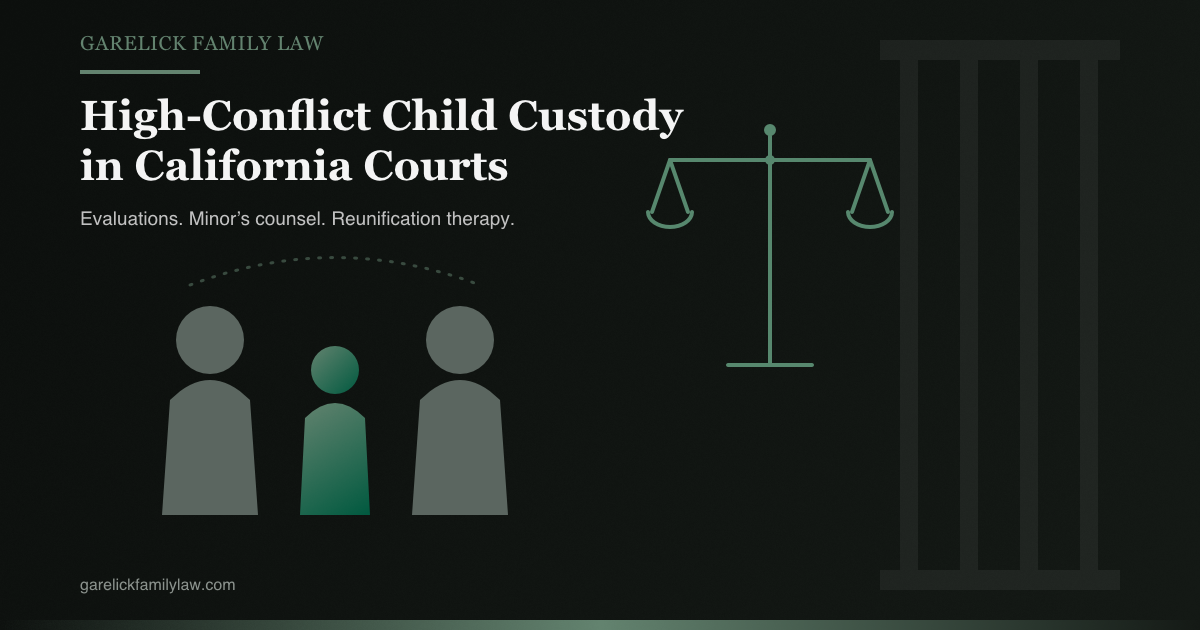
How California Courts Handle High-Conflict Child Custody Cases
A high-conflict custody California case does not play out like an ordinary dispute. It operates differently, with different tools, different professionals, different processes, and a different legal standard for what counts as a resolution the court can live with.
Most California custody cases resolve through negotiation, mediation, or a relatively straightforward court process built around the best interest of the child standard. High-conflict cases strain that framework because the ordinary assumption, that both parents can cooperate around a shared custody schedule, no longer holds. Courts respond by bringing in more oversight, more professionals, and more structure than a typical case requires.
What Makes a Custody Case High-Conflict in California
High-conflict designation is not just about the intensity of the dispute or how often the parties end up back in court. Courts apply it to cases involving a history of domestic violence or coercive control, allegations of parental alienation or a resist and refuse dynamic, significant mental health issues involving one or both parents, substance abuse concerns, or cases where the children are expressing a preference that contradicts the current custody arrangement.
What distinguishes these cases procedurally is that the court can no longer rely on the parents to self-manage the co-parenting relationship. A judge who sees repeated filings, credible allegations of coercive control, or a custody evaluation flagging concerning conduct will typically move toward more structured interventions earlier in the case rather than waiting for the situation to deteriorate further. Recognizing that a case has crossed into high-conflict territory, and doing so early, often shapes the entire trajectory of the litigation.
The Custody Evaluation Process
In most high-conflict custody cases, the court will order a custody evaluation under Family Code Section 3111 or, in more limited scope, a 730 evaluation under the Evidence Code. A court-appointed evaluator, typically a licensed psychologist with specific training in forensic family evaluations, conducts a comprehensive assessment including interviews with each parent, age-appropriate interviews with the children, observation of parent-child interactions, collateral interviews with teachers or therapists, and review of relevant records. You can find general background on how California courts approach custody evaluations through the California Courts Self-Help Center.
The process typically spans several months from appointment to final report, and the resulting report makes specific custody and visitation recommendations that carry significant weight with the court. Judges are not required to adopt an evaluator’s recommendations, but in practice courts give them substantial deference, particularly where the evaluator’s observations are detailed and well-supported.
The single most important thing a parent can do in a high-conflict custody case is to focus consistently and demonstrably on the child’s wellbeing, not on winning the dispute. Courts have seen every litigation strategy, and what moves them is evidence of genuine child-centered parenting: showing up prepared, cooperating with the evaluation process even when it is uncomfortable, and avoiding the temptation to use the evaluation as a venue to relitigate every grievance against the other parent.
When Reunification Therapy Is Ordered
In cases where a child is resisting or refusing contact with one parent, courts frequently order reunification therapy, a structured, clinician-led process aimed at repairing a damaged parent-child relationship. This is court-ordered, not optional, and attendance is monitored, typically with periodic reports back to the court on progress.
Reunification therapists work differently from general family therapists. Their mandate is specifically to rebuild contact and trust between the child and the rejected parent, often starting with supervised or limited contact and expanding as the relationship stabilizes. The process can take months or longer, and it depends heavily on the cooperation of both parents, including the parent who is not the subject of the therapy. Resistance to the process, by either parent, by coaching the child, criticizing the therapist, or undermining the sessions, can be treated as a violation of a court order and can affect custody going forward.
The Role of Minor’s Counsel
In particularly contested cases, the court may appoint an attorney for the child, called minor’s counsel in California, under Family Code Section 3150. Minor’s counsel represents the child’s interests independently of both parents’ positions, which means their role is distinct from either parent’s advocate or the custody evaluator. They can interview the child, review evaluation materials, speak with teachers and treatment providers, and make recommendations directly to the court.
Their report to the court carries independent weight and gives them access to information that neither parent may have shared with the evaluator, in part because children and collateral witnesses sometimes disclose things to minor’s counsel that they would not raise with a parent’s own attorney or even with the evaluator. In cases involving a resist and refuse dynamic or allegations of alienation, minor’s counsel’s independent perspective often becomes one of the most influential pieces of evidence in the case.
What Garelick Family Law Brings to High-Conflict Cases
Marc Garelick and Amanda Beall have specific experience with the professionals, processes, and dynamics that define a high-conflict custody California case in Orange County. They work with custody evaluators, reunification therapists, and minor’s counsel regularly, which means they understand not just the legal standards involved but how these professionals actually approach a case, what they look for, and how to present evidence in a way that supports a fair outcome for the client and, most importantly, for the child.
If you are facing a high-conflict custody dispute, the decisions made in the first weeks and months, how you engage with the evaluation process, whether you pursue reunification therapy, how you document the other parent’s conduct, often shape the outcome more than anything argued at a final hearing.
Learn more about our child custody practice or contact Garelick Family Law to discuss your case.