Short answer: Yes. In California, coercive control is a recognized form of domestic abuse even when no one has been physically hurt. Since January 1, 2021, Family Code Section 6320 has treated a pattern of coercive control as conduct a court can restrain, and the same pattern can weigh heavily in a custody decision.
For decades, domestic violence in family court meant physical abuse. That changed when the Legislature amended the Family Code to name coercive control as abusive conduct. The change matters because coercive control often leaves no bruises, no police reports, and no single dramatic incident. It leaves a pattern, and the pattern is what a court now has to understand.
What the Law Says
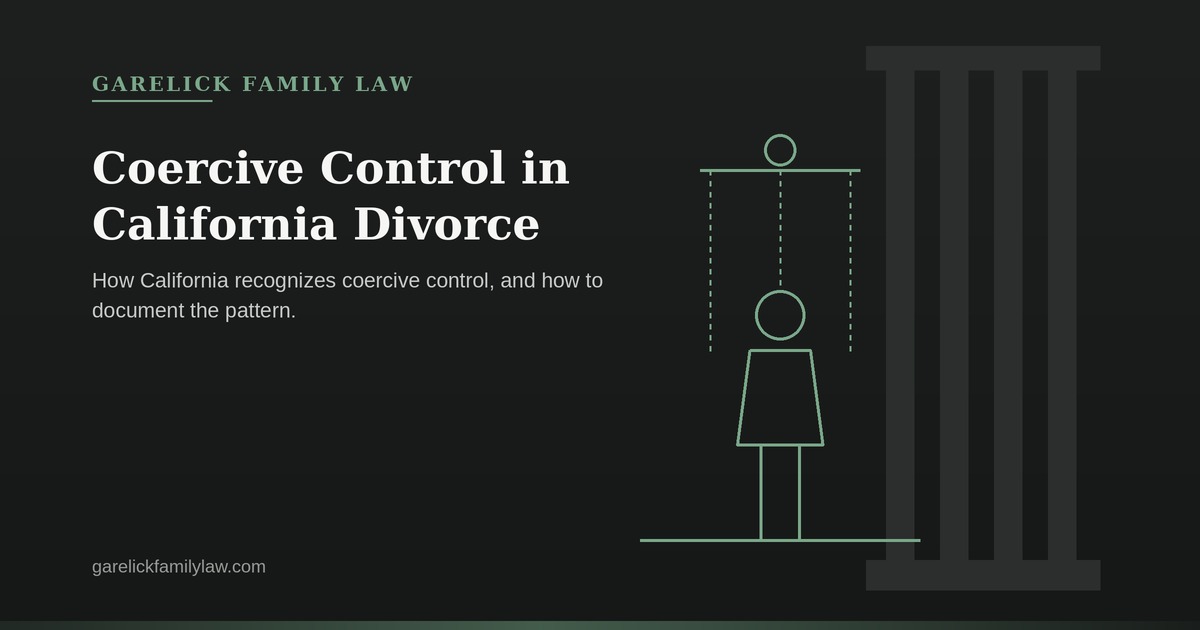
Section 6320 of the Family Code describes coercive control as a pattern of behavior that, in purpose or effect, unreasonably interferes with a person’s free will and personal liberty. The statute gives examples, including:
- Isolating the other party from friends, relatives, or other sources of support;
- Depriving the other party of basic necessities;
- Controlling, regulating, or monitoring the other party’s movements, communications, daily behavior, finances, economic resources, or access to services; and
- Compelling the other party by force, threat of force, or intimidation, including threats based on actual or suspected immigration status, to engage in conduct from which the other party has a right to abstain or to abstain from conduct in which the other party has a right to engage.
No physical violence is required. A court looks at the whole course of conduct, not just the most recent incident.
What Coercive Control Actually Looks Like
In practice, the behavior is often framed as concern, convenience, or tradition, which is part of why it goes unrecognized for years. Courts and family law attorneys see patterns such as:
- Controlling access to money, including cutting off a spouse from joint accounts or demanding receipts for ordinary purchases;
- Tracking a spouse’s location or phone, or demanding passwords;
- Isolating a spouse from friends and family, or punishing contact with them;
- Threatening to harm the spouse, the children, or pets, or threatening to take the children;
- Humiliating or degrading a spouse in private or in front of others;
- Controlling when a spouse can sleep, work, drive, or seek medical care.
Any one of these might look minor in isolation. The legal significance comes from the pattern and from its effect on the person living with it.
Why Documentation Is Everything
The central challenge in coercive control cases is that the pattern is often invisible to everyone outside the relationship. A judge cannot weigh what has not been shown. Evidence that helps includes:
- Text messages, emails, and voicemails that show controlling or threatening behavior;
- Financial records that show who controlled the accounts and how money was restricted;
- Testimony from friends, relatives, coworkers, or neighbors who saw the isolation or its effects;
- Records from doctors, counselors, or others that reflect the effect on the person (your attorney can advise on privacy before these are used);
- A dated timeline or journal written close to the events, kept somewhere the other person cannot access.
One caution: do not log into the other person’s accounts or devices without permission to collect evidence. That can create legal problems for you and can undermine an otherwise strong case.
Coercive control cases are not about one bad incident. They are about a pattern. The pattern is what the court needs to understand, and building that picture requires both legal skill and patience.
How Coercive Control Affects Custody
Evidence of coercive control is directly relevant to custody. Under Family Code Section 3044, when a court finds that a party seeking custody of a child has committed domestic violence within the previous five years against the other party seeking custody of the child, or against the child or the child’s siblings, or against a person with whom the party has a relationship, a rebuttable presumption arises that giving that parent sole or joint physical or legal custody of a child to a person who has perpetrated domestic violence is detrimental to the child. Domestic violence for this purpose includes conduct that could support a restraining order under Section 6320, and that is how coercive control reaches the custody analysis.
The presumption can be overcome, but the burden is on the parent who is subject to it. That parent must show that custody is in the child’s best interest and that other factors support the finding, such as completing a batterer’s intervention program, complying with protective orders and probation, and the absence of further abuse. The statute also says the general preference for frequent and continuing contact with both parents cannot be used to rebut the presumption. A court cannot base a Section 3044 finding solely on a custody evaluator’s conclusions or a Family Court Services recommendation, which makes the underlying evidence even more important.
Effects Beyond Custody
Coercive control can also shape other parts of a divorce. Documented domestic violence is one of the factors a court considers in deciding spousal support under Section 4320. Spouses also owe each other fiduciary duties when managing community property (Family Code Section 721), so a spouse who used control over the finances to hide, waste, or divert assets can face remedies under Section 1101. A careful financial review is often part of these cases.
Getting Protection in Orange County
A person experiencing coercive control can ask the court for a domestic violence restraining order, which can include stay-away, no-contact, and move-out orders and can address temporary custody. In Orange County, domestic violence and family law matters are heard at the Lamoreaux Justice Center in Orange. If there is immediate danger, call 911 first. For more on what a restraining order does and does not do, read our guide to what a DVRO actually protects you from.
If You Have Been Accused of Coercive Control
Garelick Family Law handles both sides of this issue in Orange County. If you have been accused, the priorities are different but just as urgent: follow every court order exactly, avoid contact that an order prohibits, preserve your own messages and records, and do not retaliate or contact witnesses to pressure them. Accusations of coercive control are scrutinized, and a measured, documented response is more persuasive than an angry one.
Frequently Asked Questions
Is coercive control a crime in California?
Coercive control is recognized in California’s family law statutes and can support a civil restraining order and affect custody. Whether particular conduct is also a crime depends on the specific acts, such as threats, stalking, harassment, or violating a protective order.
Do I need physical abuse to get a restraining order?
No. A restraining order can be based on a pattern of behavior that the Family Code describes as coercive control, as well as on other abusive conduct. A court needs reasonable proof of the conduct.
Can coercive control affect child custody?
Yes. If a court finds domestic violence within the past five years, Family Code Section 3044 creates a rebuttable presumption against awarding sole or joint physical or legal custody to the parent who committed it.
How do I prove coercive control?
Most cases are proved through a pattern of evidence: messages, financial records, witness testimony, and a contemporaneous timeline. No single document usually tells the whole story.
How long does a restraining order last?
After a hearing, a court can issue a restraining order for up to five years, and it can be renewed. Your attorney can explain how that applies to your situation.
Talk to a Family Law Attorney
If you are experiencing coercive control, or have been accused of it, speak with an attorney who understands how to present or defend a pattern case. Learn more about our domestic violence practice in Orange County or contact Garelick Family Law to schedule a consultation.
Related Reading
- How to Prepare for a Custody Evaluation in Orange County
- What a DVRO Actually Does and Does Not Protect You From